Why response speed decides
When a customer asks for a service or repair, they usually write to multiple businesses at once. Whoever reacts first has a huge advantage — they often win the job before the competition has even read the email. We see this constantly from our own experience with service websites.
The key moment: between sending an inquiry and the competition calling, you have a window of minutes or hours. If you send a relevant and specific quote during that time, you come across as a professional who has their processes under control.
The reverse works just as ruthlessly — a slow or generic response disqualifies you, even if you are cheaper and better. For service companies, inspection technicians, and tradespeople, this applies doubly.
What to build a knowledge base from
The foundation of automation is not magic, but the ordinary data you already have. It is just a matter of pulling it out of your heads and emails.
What to collect:
- Recurring email questions: every “how much does an electrical inspection cost for a 200 m² office” is a valuable sample
- Phone inquiries: write them down — after a week, you will see that 10-15 scenarios repeat themselves
- Customer objections: “why is it more expensive than last time” or “how long will it take” are great raw material for FAQs and the base
- Your standard responses: the ones you write over and over — you probably already have them in your sent mail
Practical tip: create a shared document where the team records recurring weekly questions. In a month, you have raw material from which you can build both website content and automation rules.
A website built this way can generate inquiries even without advertising. For example, with our SOHE.cz project, 100% of search traffic is brought in by new expert articles — precisely because they answer what people are actually looking for.
How to set rules so AI does not suggest nonsense
Before you let AI near a form, you must teach it your business logic. This means not just answers, but also boundaries.
Step-by-step process:
- Gather the most common inquiries — the goal is to cover the majority of recurring scenarios
- Create answers and business rules — this includes limits (“we travel free up to 50 km, over 50 km we charge 8 CZK/km”), minimum order values, deadlines
- Set guardrails — what AI must never promise: discounts, deadlines without consultation, price without an inspection
- Connect the form or email — ideally so that the inquiry comes into the system, AI classifies it and proposes a response
- Let AI only suggest — a human must always make the final dispatch
- Measure time and outcome — track how much you sped up the first reaction and whether conversion is growing
Human oversight is also crucial legally — if a quote were generated fully automatically and contained an error, you have a problem. That is why we build all our automations so that the machine prepares, and the human confirms. The last word always belongs to the one who bears responsibility.
How to measure it and prove to yourself it works
Improving without numbers is guesswork. For quote automation, it pays to track only a few key metrics.
Measurement checklist:
- Time from inquiry to first reaction — before deployment and after deployment
- Conversion from inquiry to order — whether a faster reaction increases success rate
- Number of proposals that passed without edits — an indicator of knowledge base quality
- Most common reasons for rewriting — from this, you learn what is still missing in the rules
- Time saved per quote — multiply by the number of quotes per month, and you get ROI
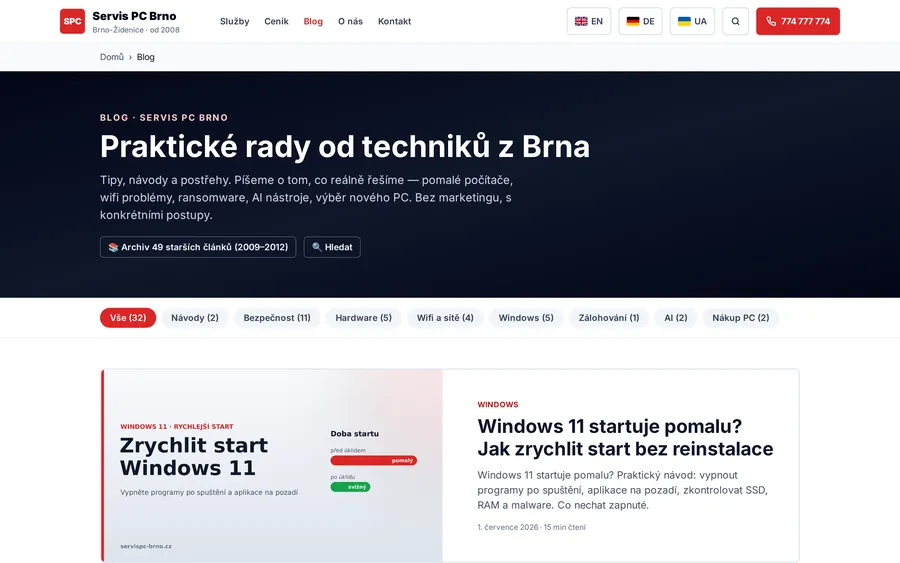
Data from our projects show that a systematic approach to content and processes brings results quickly. For the ServisPC-Brno.cz website, weekly clicks from Google grew for 6 weeks in a row: 0 → 5 → 15 → 32 → 37 → 52. That is not a miracle, but the consequence of methodically adding relevant content that answers real queries.
When it is better to write a quote manually
Automation is not for everything. There are situations where a personal approach is better and faster.
A manual quote is worthwhile when:
- The inquiry is non-standard and requires understanding a deeper context
- It is a strategic customer where the risk of error is too high
- The job value is above the usual limit and it is worth giving it individual attention
- From the inquiry text, you sense that the customer mainly needs reassurance and education, not a quick off-the-shelf answer
A good salesperson knows when to switch off the machine and engage their own brain. In practice, we solve this with a “suggest” button for each incoming inquiry — the choice is always yours.