“You have to be making videos.” But when, if you barely keep up with the jobs
You hear it at training days, at networking events and from the nephew who “does social media”: video is the future, without video a business doesn’t exist today. Then you go back to the workshop or the office, where an unfinished job is waiting, and it’s clear your capacity is one thing a month. One video, or one article. Not both.
So the question isn’t whether video works. It does, just as text does. The question is: which pays off first when I can only do one? And there is a sober answer to that — it just depends on your industry and on how customers reach you.
Text and video play in different leagues
The most common mistake in this debate is pitting text and video against each other as if they did the same job. They don’t.
An article on your website is a machine for enquiries from search. A customer types “boiler humming after the heating comes on” into Google, or asks an AI a full-sentence question — and the answer comes from text. Search engines and AI assistants work primarily with words: they can crawl text, understand it, quote it and serve it to exactly the person dealing with your line of work right now. An article also keeps working for years, and when something changes you fix it in twenty minutes.
Video is a machine for trust. It shows how you speak, what your work looks like up close, whether you come across as someone a customer would let into their home. On social media it has reach that text will never have, and in the trades a single shot of a job done cleanly says more than three paragraphs of description. But it won’t bring in enquiries from search on its own — a video with no accompanying text is all but invisible to a search engine. Google’s documentation states explicitly that a video should be on a public page and accompanied by text saying what it’s about.
| What you need | Rather text | Rather video |
|---|---|---|
| To be found by a customer searching for a solution right now | ✓ | |
| To be recommended by AI tools | ✓ | |
| To show the quality of the work you deliver | ✓ | |
| To build trust and a personal connection | ✓ | |
| To update cheaply when something changes | ✓ | |
| Reach on social media | ✓ | |
| To answer a question before the enquiry | ✓ | supporting role |
The table points to one simple thing: if enquiries are what you’re missing, you first need to be findable — and that is text’s job. If people do find you but never get in touch because they don’t know you, trust is what helps — and that is where video comes in.
Ask where your next customer will come from
Before you decide, answer a single question: what does a person with the problem you solve actually do?
With a blocked drain, a broken e-shop or a letter from the tax office, they go searching — to Google, and increasingly to an AI assistant. At that moment the business whose website answers their question wins. How to find out what your customers are asking is covered in How to spot the topics customers are searching for — and those exact topics are the pool for both articles and videos.
But when they’re choosing a fitted kitchen, a hairdresser or a bathroom renovation, they decide with their eyes. They browse finished jobs, scroll through profiles, compare how the work looks. Text alone isn’t enough there — you need to show results, and video or photos of your own jobs are the strongest argument.
By industry: what comes first
Trades and on-site services (plumber, electrician, repairs, cleaning): text first. Customers look for you at the moment of an urgent problem and want an answer and a phone number, not a show. Add video as a second step — short clips from completed jobs that you embed in articles and post on social media as proof of your work.
Professional services (accountant, solicitor, IT, consulting): text first, without question. You’re selling confidence in your expertise, and customers verify that by reading — how clearly you explain things, whether you understand their situation. Text has one more advantage here: it’s exactly what AI assistants draw on when someone asks for a recommendation. What decides who the AI quotes is described in How to write content so AI quotes you.
Industries that sell on looks (hospitality, design, joinery, fitness, beauty): here video and photos come first, because the decision is made with the eyes. Even so, you need a website with text — as the place a customer arrives from social media to check prices, scope and contact details, and where the people who aren’t on social media can find you too.
Businesses that live on referrals: if referrals are the only thing bringing you work today and you want to keep it that way, video makes sense for maintaining your relationship with the people around you. But if you want to stop depending on who happens to think of you, you need to be findable — and we’re back to text.
Count the time, not just the money
Video gets talked about as if all it took was to “get your phone out”. An honest tally of one usable answer on camera: work out what to say, two rounds of three takes, edit, add subtitles (a large share of people watch with the sound off), come up with a thumbnail, upload, write the description. Even at modest production quality that’s half a day — and when the price or the procedure changes a month later, you can’t patch a video, you shoot it again.
An article costs time too; no work is free. But it can be corrected, extended and expanded without a new shoot, and above all: every article adds to the ones before it. A website with twenty answers shows in search and in enquiries; twenty videos scattered across social media vanish into the feed within a week. What an article that genuinely brings in an enquiry looks like — with a clear question, an answer and a next step — is described in How to write articles that bring in enquiries.
This isn’t absolute. If speaking comes easily to you and writing blocks you for weeks, a video that gets made beats an article that doesn’t. It’s for exactly this case that there’s a way to combine both routes.
One job, two channels: film the answer, turn it into an article
The most practical compromise for a business with capacity for “one thing a month” looks like this:
- Pick one real customer question. Not a made-up topic — a question you’ve heard on the phone at least twice this month.
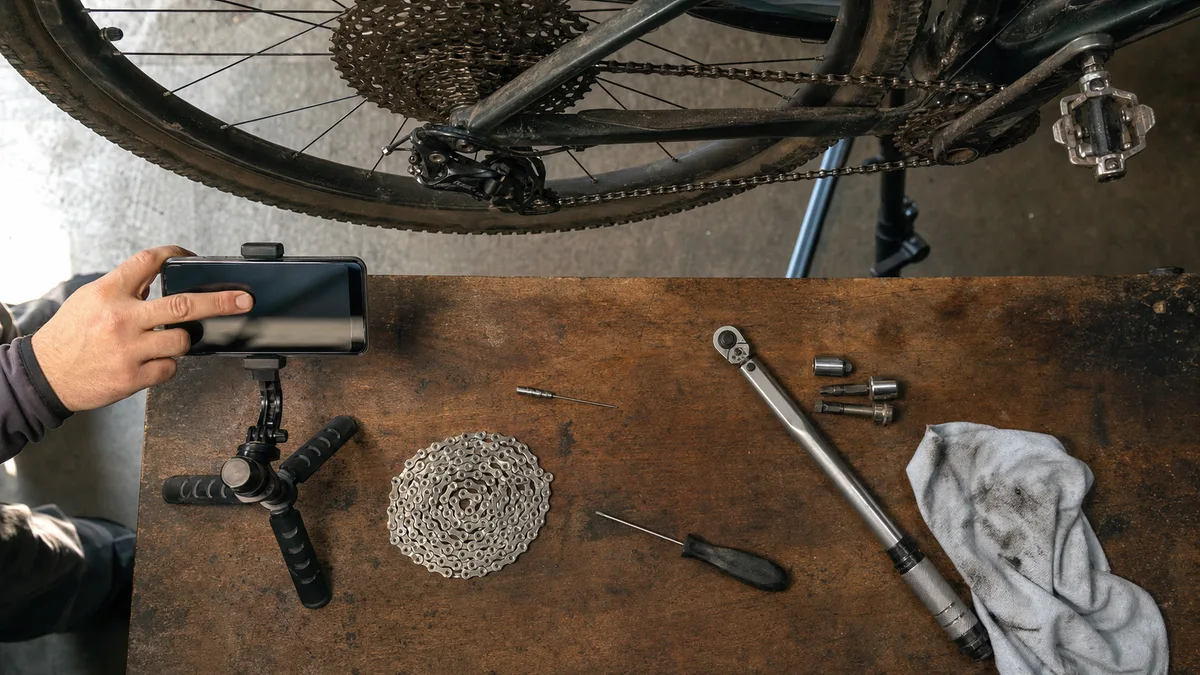
- Film the answer on your phone. Two to five minutes, talk as you would to a customer. Tripod, daylight, quiet surroundings. It doesn’t have to be perfect, it has to be clear.
- Have the recording transcribed. A phone or a free tool handles transcription in a few minutes these days.
- Turn the transcript into an article. Spoken words can’t be published as they fall — add headings, reorder things, fill in what you skipped in the recording and, above all, add a next step for the reader. This is where an editor helps if you don’t have time for the rewrite.
- Publish both. The article on your website, the video on YouTube and social media — and embed the video in the article. The text makes sure search finds the page; the video raises trust once people are on it.
One filming session a month = twelve articles and twelve videos a year. No duplicated work, no “either/or” decision. How to build that routine over your first three months is shown in the 90-day content plan.
How you’ll know you bet right
Whatever you choose, give it an honest review after a few months — otherwise you’ll stick with the format out of inertia rather than because it works.
For articles, look in Search Console: is the page appearing for queries from people dealing with your line of work? Do readers move from the article to a service page or to your contact details? For videos, watch whether people get at least halfway through and whether anyone moves from them to your website — a thousand views after which nobody clicks and nobody calls is entertainment for the algorithm, not a business result.
And the same yardstick applies to both: did the content show up on the path of a real enquiry? Ask on the phone where the customer found you and what they read or watched about you beforehand. The answers won’t be precise, but after a few months you’ll see a pattern — and that pattern decides where the next hours go. The whole process of evaluating everything from queries to jobs is covered in How to tell whether content is paying off.
How to decide in your case
To sum up, without cheering for either side:
- You’re short on enquiries and your website doesn’t answer customer questions → text first. Video only as an extra.
- You sell on looks and finished work → video and photos of completed jobs as soon as possible, but backed by a website with text.
- People find you but don’t get in touch → the problem usually isn’t the channel but trust and what the website says; a short video with your face on it helps more here than another article.
- Speaking comes easier to you than writing → film and transcribe. One job, two channels.
If you’re unsure which situation is yours, don’t guess. The decision about where to put your limited time can rest on data: what people in your field are searching for, what your website already answers today, and how your last real jobs actually reached you. That is exactly what the initial analysis goes through — and the result is a recommendation on whether your first hour a month should go into writing, into filming, or into a smart combination of the two. What such an analysis and ongoing content work cost is set out in the pricing.
One last note on trends: the next time someone tells you that “a business doesn’t exist without video”, ask them where their last job came from. The answer is surprisingly often “someone found us on Google” or “a customer referred us”. Content — in whatever format — should reinforce that path, not chase whichever format happens to be in fashion.