Google answers before anyone clicks through to you
Type “how often does a chimney need inspecting” into Google. There’s a fair chance you won’t see links at the top, but several paragraphs of a finished answer — assembled by artificial intelligence right inside Google, with links to the source sites off to the side. Google calls these AI Overviews. They’ve been showing since 2024, gradually in more countries and languages, and increasingly on queries that used to lead reliably to business websites.
For the person searching, it’s convenient: the answer arrives in five seconds and there’s nothing to click. For the site the answer was built from, the news is worse — the reader got the main thing without ever setting foot on the site.
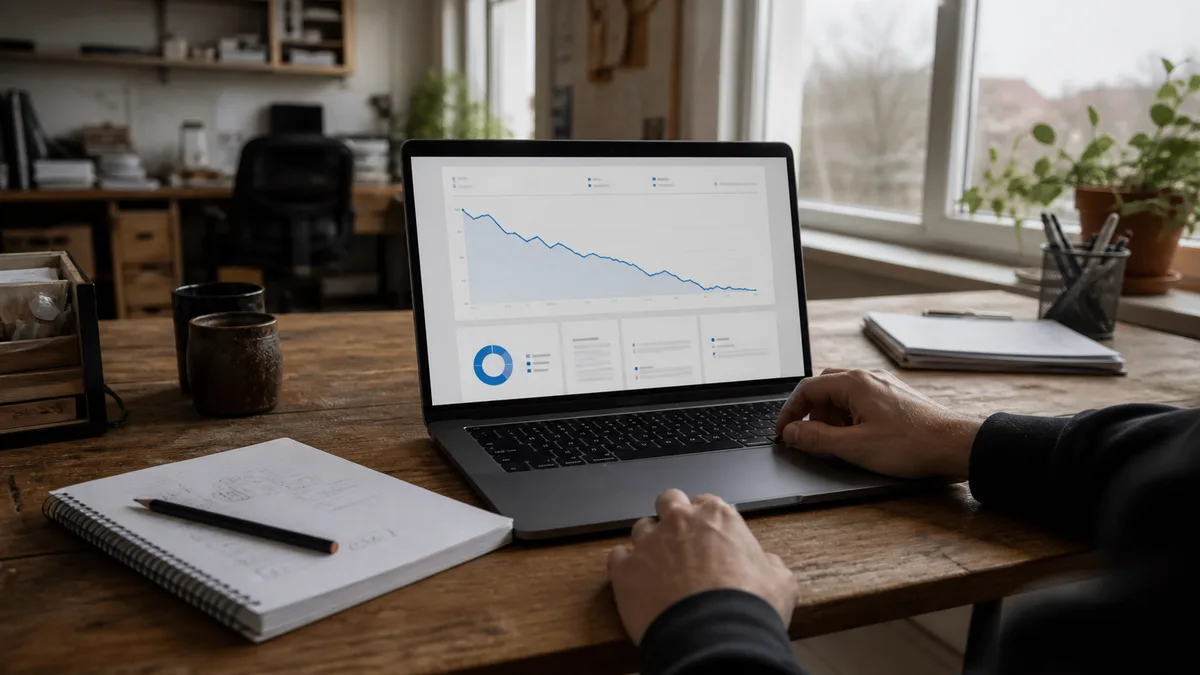
A business owner usually doesn’t experience this as a change in search, but as an unexplained dip in the numbers. The site is the same, the articles are where they always were, positions haven’t shifted dramatically — and yet traffic from Google is falling. Publishers and site operators around the world report drops on informational articles in the tens of percent. How big it will be for any particular site can’t be predicted in advance; the direction, though, is the same everywhere.
This article is about what can be done about it. But first, honestly, about what can’t.
How to spot the change in your own numbers
Open Google Search Console, the Performance report, and compare the last three months with the same period a year earlier. The typical picture looks like this:
- Impressions hold steady or grow. Google keeps showing your pages, perhaps more than before.
- Clicks fall. Fewer people click on a page that’s been shown.
- CTR — the ratio of clicks to impressions — goes down, most of all on queries starting with “how”, “what”, “why” and “how much”.
That’s not a penalty or a broken site. The page still appears — it’s just that a finished answer often sits above it, so some searchers no longer have a reason to click.
One thing is worth saying up front: Search Console won’t show you in black and white what an AI Overview caused. Google doesn’t break out overview data — impressions and clicks from them are buried in the totals and no separate filter exists. A drop on informational queries while impressions hold is therefore strong evidence, not a signed verdict. Look for the pattern: if queries with your company name and queries like “price”, “contact” or “[service] [city]” are holding while it’s mainly the general questions that fall, you have your answer.
What a small business can’t control — and it’s fair to know that up front
Whether an overview appears for a query. Google decides that query by query and keeps changing its mind. No change on your site will guarantee that an overview won’t appear for your topic — nor that you’ll be the one in it.
A place in the answer can’t be bought. An AI Overview has no ad slot you could pay for, and nobody can honestly guarantee that an overview will cite you. Anyone promising a guarantee is promising a decision they don’t make. The same applies here as to guaranteed search positions: a reputable supplier doesn’t offer them.
Opting out is effectively impossible. Google offers no standalone “I don’t want to be in AI Overviews”. Technically you can limit what Google may display from your text — with rules such as nosnippet — but those same rules also cut back your ordinary snippets in the search results. A business site would strip itself of visibility everywhere, and that isn’t a commercially defensible route.
People’s behaviour. Some customers will get used to answers without clicking, and no business will reverse that habit. It’s a change in the environment, not a fault in your site — and it’s dealt with by adapting, not resisting.
What can be influenced: two routes, both running through content
Route one: be a source Google builds its answer from
An AI Overview doesn’t come from nowhere. Google builds it from specific pages and links to the sources. When your site is among them, your name stands right where the customer is looking for a solution. Not everyone clicks — but a name next to the answer is worth many times more than not being there at all. It works like a recommendation: when they come across the company a second time, in reviews or on a map, they already recognise it.
How to write so a machine can pull an answer out of your text — a definition right at the start of the section, sentences that make sense even taken out of context, specific parameters instead of vague phrases — is covered in detail in How to write content so AI cites you. Here, just the essentials: this isn’t a new discipline with secret tricks. It’s a well-written expert text, and it costs nothing but the work.
Route two: aim at queries where a ready-made answer isn’t enough
For a small business, this route matters more. AI can answer a general question. It can’t turn up on site, quote a binding price or hold a slot in the diary.
| Customer query | Can an AI answer handle it? | Who wins |
|---|---|---|
| ”how often to inspect a gas boiler” | Yes, in general terms | The AI Overview — don’t count on many clicks |
| ”gas boiler inspection Vyškov” | Only halfway — they want a specific firm | Firms with a complete local profile and a service page |
| ”boiler inspection price and availability” | No — price and dates belong to a specific supplier | The site that states the price and the date up front |
| ”reviews of company XY” | No — trust is verified with people | A firm with reviews, references and case studies |
In practice this means reshuffling the order in which content gets made:
- Service pages before general articles. A page like “Gas boiler inspections in Brno” with an indicative price, a typical lead time and a clear next step is content no AI Overview can replace.
- Local queries. For searches that include a city name, both Google and AI reach for firms with complete profiles and a local footprint — how to build one is described in Local SEO for a small business.
- Pre-order questions. “How long does it take, what should I have ready, what if a fault is found” — the questions of someone already choosing a supplier. The question-and-answer format is ideal for them and gets read by people and machines alike; the how-to is in FAQs on your site: how to answer customers and AI.
- Don’t scrap general articles, just stop expecting traffic from them. They still build the expertise that citations are assembled from — but they’ve stopped being the main source of visits, so budget your time accordingly.
Measure enquiries, not visits
The worst possible response to AI Overviews is chasing lost traffic with more general articles. You’ll produce more text for queries Google answers itself, and in six months you’ll be exactly where you were — just with higher costs.
Traffic from informational queries will most likely fall even if you do everything right. So move your yardstick for success to where the money is decided: how many people moved from content to a service page, how many enquiries came in and how good they were. How to set up that kind of measurement is described in How to tell whether content is paying off — and in the age of AI Overviews it counts double. A firm whose visits fell by a third while enquiries stayed put has lost nothing that matters. A firm that measures only visits will panic in the meantime and start making bad decisions.
What to do this month
- Open Search Console and split your most important queries into two piles: general questions, and queries with a city, a price or a company name. For each pile, compare clicks year on year. You’ll see where AI answers are actually hitting you.
- Type your ten key queries into Google and note where an AI Overview appears and which sites it cites. If a competitor is there and you aren’t, look at how their page differs — usually it answers more directly.
- Check the AI assistants too. Customers don’t only ask Google — how to find out whether ChatGPT and Copilot recommend you is described in What ChatGPT says about your company.
- Go through your service pages through the eyes of someone AI has just given a general answer to and who is now looking for whoever will do the job: is there at least an indicative price, a typical lead time, a service area and a clear call to the next step?
If you’d rather not decide from behind a desk on a hunch, this is exactly the job for an initial analysis: it goes through your Search Console data, separates the queries an AI answer has already taken over from the ones where the click and the enquiry are still up for grabs, and proposes an order of steps by payoff. The ongoing work is then taken over by content creation and management — scope and indicative prices are in the price list.
Search has changed and the old state of affairs isn’t coming back. But a small business isn’t competing with Google over who answers a general question — it’s competing for the customer who needs a price, a date and someone they can trust. And there, no automatic answer is enough.