
Customers Check You Out Before They Ever Call
A lead doesn’t start with a form on your website. It starts a step earlier — in the evening, on a phone, when someone types “electrician Vyškov” or “accountant for an LLC in Olomouc” and forms an impression within a minute: this business has 4.8 out of fifty reviews and the owner replies to them, that one has three ratings and the last one is two years old.
You’ll never find out about this silent selection process. Only the person who picked you will call. The rest go to a competitor without a trace — you won’t see them in your website analytics, because they often never even reached your site. That’s why reviews aren’t cosmetic profile polish, but one of the places where leads are actually decided.
Why Reviews Matter: Maps, Trust, and AI
In local search, reviews are part of the ranking. Google’s help documentation states that it builds local results from relevance, distance, and a business’s “prominence” — and prominence factors in both the number of reviews and the rating. That doesn’t mean more stars equals first place. It means a business with no reviews is playing with a handicap that’s hard to make up any other way. How to set up, fill out, and keep a full business profile alive is covered in the article local SEO for a small business — here, we’ll stick to reviews.
When it comes to the decision itself, the text matters more than the average. The star rating decides whether someone even clicks through to you. But then they read: what customers specifically praise, how the business reacts when something goes wrong, and whether the most recent review isn’t a year old. A sentence like “they showed up the next day, the price matched exactly what we agreed” answers the questions a future customer is really asking — and answers them in the customer’s own words, not your marketing copy.
AI assistants build their recommendations from public data. When someone asks ChatGPT or Copilot who to contact for a bathroom renovation in Liberec, the answer is put together from whatever is publicly findable about businesses: ratings, reviews, directory listings, mentions in articles. No tool has published its exact formula — but it’s certain that a business nothing can be found about has nothing to be recommended on. Alongside website content, reviews are the second raw material AI draws on; the first is covered in the article how to write content so AI cites you.
When and Who to Ask for a Review
The most common reason a business has no reviews isn’t unhappy customers. It’s that nobody asked. A happy customer usually won’t write a review on their own — not out of ill will, they just forget about it by evening.
A simple combination works:
- The right moment. Right after completion, while satisfaction is fresh — the customer takes delivery of the finished work, thanks you by email, praises you on the phone. Three weeks later, it’s a cold request nobody answers.
- The right person. A request from whoever did the job works best. A personal “I’d really appreciate a few words from you” carries more weight than an automated message from a noreply address.
- Every customer, not a selection. Ask for a review after every completed job, not just the ones where you expect five stars. Partly because the rules require it (more on that shortly), and partly because an occasional four-star review with a fair complaint looks more credible than a smooth wall of nothing but five stars.
- One reminder is enough. If the customer doesn’t respond, send one polite reminder after a week. No more than that — a request turns into pestering, and pestering gets you deleted from their contacts.
And the wording? Ask about the experience, not the star rating: “Please let us know how satisfied you were with the timeline and price — it’ll help other customers make their decision.” A request like that leads to a review with text that actually says something. It’s the written reviews that future customers read most closely.
Make It Easy: Direct Link and QR Code
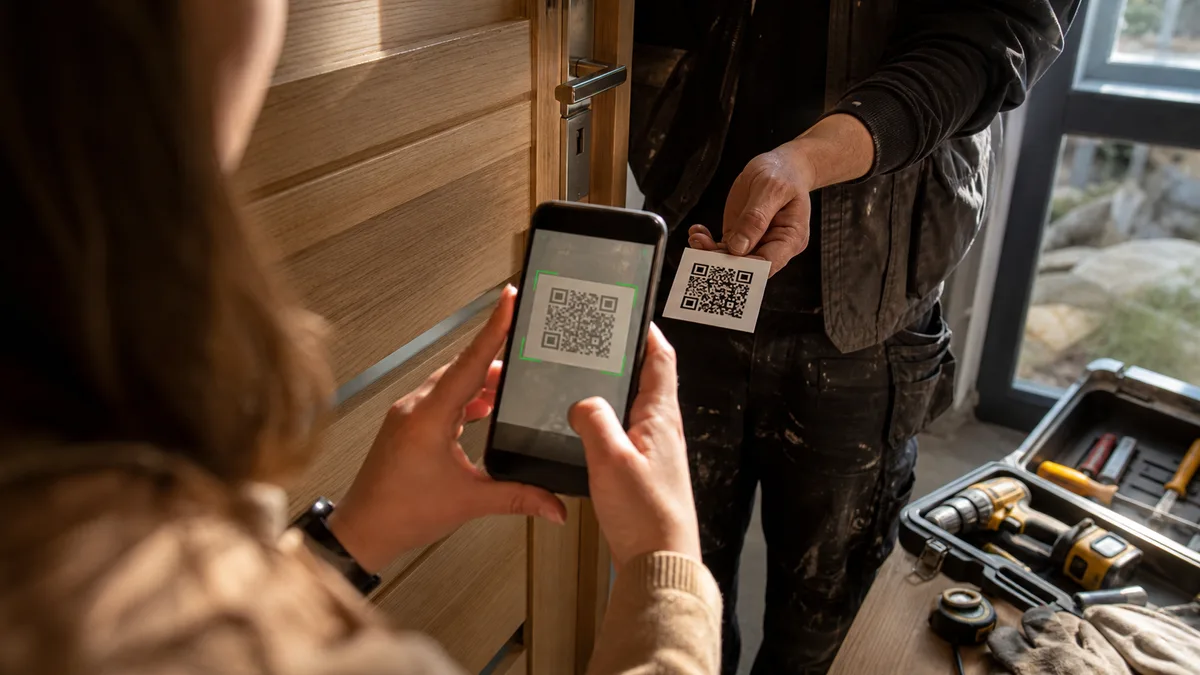
Every extra step means lost reviews. A customer who has to google your business themselves, find the right button, and click through several screens usually just gives up. That’s why Google’s profile management offers a direct link for writing a review and can generate a QR code from it too — both free, in under a minute.
What works well in practice:
- A link in the thank-you email, right below the thanks, with one sentence explaining why.
- A QR code on the handover form or invoice — for trades and services, this is the moment the customer is most receptive.
- A QR code card at the counter for brick-and-mortar businesses.
- A text message with the link where you communicate with the customer by phone — short, personal, sent the same day: “Hello, thank you for today’s job. If you have a minute, I’d appreciate a review — it helps other customers: [link]. Novák, Electrical.”
There’s one limitation you can’t change: to write a Google review, the customer needs a Google account. Anyone without one won’t be able to write a review, no matter how much you smooth the path. That’s also why it’s worth having a second platform alongside Google — we’ll get to Firmy.cz further down.
What’s Forbidden — and What Can Take Down Your Entire Profile
This needs to be said bluntly, because offers like “we’ll get you thirty reviews within a month” land in small businesses’ inboxes all the time. Google’s policies for contributions in Maps are unambiguous:
- Bought and fake reviews. A review must describe a real customer’s real experience. Purchased packages, ratings from other people’s accounts, reviews written to order — Google continuously detects and removes all of this. A business involved in fake engagement can have its entire profile restricted or suspended. Losing a profile with dozens of honest reviews over ten bought ones is a terrible trade.
- Rewards for reviews. A discount, gift, contest entry, or money in exchange for a review is against the rules — even if you’re asking the customer for an honest one. An incentive also can’t be tied to editing or deleting a negative rating.
- Filtering out happy customers, so-called review gating. Sending every customer a satisfaction survey, routing unhappy ones to an internal form, and only letting the enthusiastic ones through to Google — this is exactly what the rules forbid: you can’t discourage negative reviews or collect positive ones selectively. The fact that some commercial “review management tools” offer this exact approach doesn’t change the ban.
- Reviews from your own people. You yourself, your employees, or an arranged review swap with another business (“you review me, I’ll review you”) — none of this is a customer experience, and Google treats it as the same violation as bought reviews.
And it’s not just about Google’s rules. Since the amendment to the Consumer Protection Act took effect in January 2023, fake reviews have also been a prohibited commercial practice under Czech law — and a business that publishes reviews should be able to explain how it ensures they come from real customers. Cheating with reviews, then, isn’t a gray area — it’s a risk on two fronts at once.
Negative Reviews: It’s Mainly Future Customers Who Read Your Reply
Every business gets a bad review sooner or later. But it’s usually not the one-star rating itself that costs you leads — it’s silence, or an argument underneath it.
Write your reply knowing that it’s not really the review’s author who reads it, but the dozens of people who come after them:
- Thank them and acknowledge what’s true. “You’re right, we missed the deadline” disarms more than three paragraphs of explanation.
- Add factual context if it’s missing from the review — without excuses and without counterattacking.
- Offer a solution and move it off the review: a phone call, an email, a concrete fix.
- Sign with your name. A personal signature reads as a commitment; an anonymous “the team” reads as a template.
What to avoid: sarcasm, blaming the customer, publishing details about them (name, job address, amounts — this is a matter of privacy protection, not just courtesy), and replies written in the heat of the moment. Write a draft, let it sit for an hour, and only then send it.
For a review that’s fake or from someone who was never your customer, reply factually (“we can’t find you in our customer records, please get in touch with us…”) and report the review directly through your profile management. But keep in mind that Google only removes reviews that violate its policies — not reviews that are “merely” unfairly harsh. The assessment takes days to weeks and might not go in your favor; a factual reply under the review therefore remains your most reliable defense.
Firmy.cz and Mapy.cz: The Second Pillar Czechs Actually Use
Some Czech customers don’t search on Google but on Seznam — and they look up businesses on Firmy.cz and Mapy.cz, where ratings from Firmy.cz also appear. The same principles apply there as on Google: a well-maintained listing with the same details as everywhere else, steadily growing ratings, and replies to them.
In practice, this means having two links ready and letting the customer choose: “You can write a review on Google or on Firmy.cz — whichever suits you.” That way, a customer without a Google account still has somewhere to write, and you’re not building your entire reputation on a single platform. In fields where customers live on specialized portals (accommodation, dining, trade directories), add that one too — but don’t spread yourself across five places you won’t keep up with. Two well-maintained platforms beat five dead ones.
Turn Reviews Into a System, Not an Accident
A business with six reviews after two years usually didn’t have too few happy customers. It had zero process. And yet very little is needed:
- requesting a review is a fixed step in every job — in the checklist, in the thank-you email template,
- you make the link and QR code once and use them permanently,
- you reply to every review within a few days,
- once a month, you check how many reviews came in, what customers keep repeating in them, and whether that matches what people ask about in inquiries.
The last point is the most valuable and the one most often skipped: reviews are free market research. If customers keep praising your speed and reliability over and over, and your website mainly talks about your tradition since 1998, you’re writing about something other than what people are actually buying from you.
And if you want to set up reviews, your business profile, website, and lead measurement systematically as a single chain — not as four separate things you have to think about individually — that’s exactly the work we do as part of content creation and management. Get in touch via contact and we’ll go through where your lead chain is losing them.