
Why traffic isn’t the main thing
Business owners often only track visitor numbers. When the numbers don’t grow, they logically look for a problem in their ads or rankings. But take a look at your Google Search Console: how many of those people actually picked up the phone?
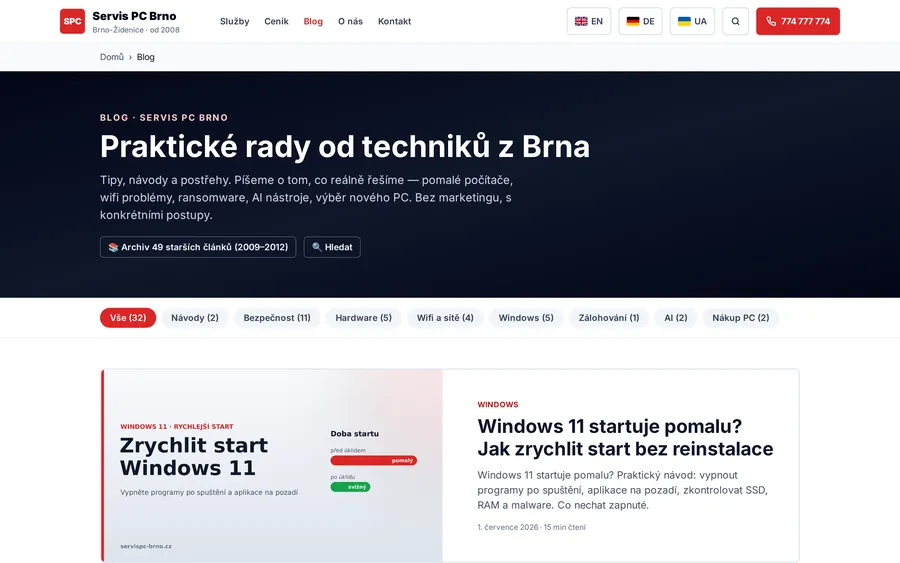
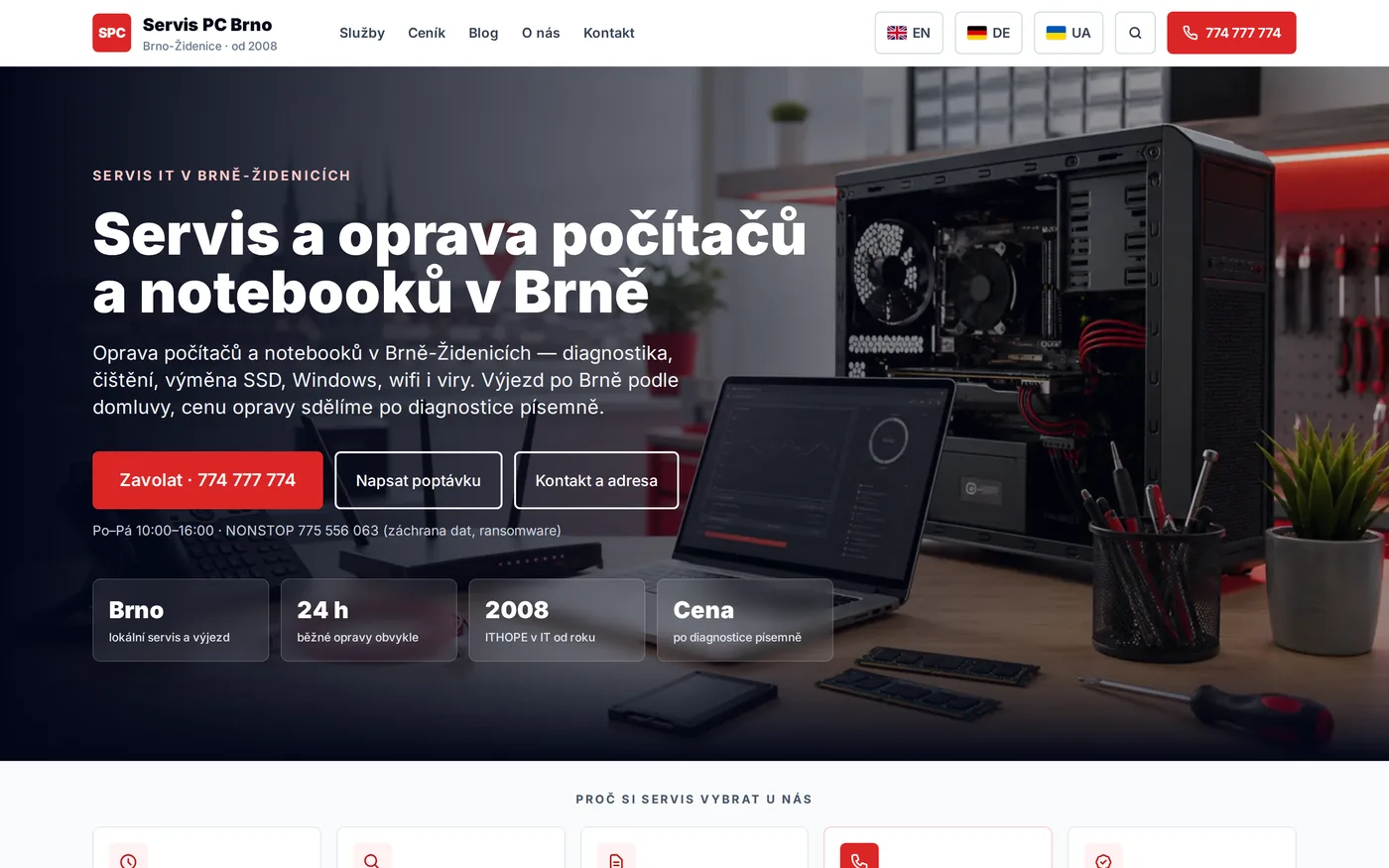
The website ServisPC-Brno.cz initially had negligible traffic. Instead of chasing numbers, we built content around the exact faults people type into search engines – “laptop fan not working” or “screen dimmed after a drop.” The result: weekly clicks from Google grew for 6 straight weeks: 0 → 5 → 15 → 32 → 37 → 52.
A lead is born the moment a specific query meets a specific answer. Not from a traffic chart.
The website as a brochure vs. the website as a tool
Most business websites describe the company, its history, and its values. That’s a brochure. It doesn’t sell – unless the customer is already decided and just needs a phone number.
A website as a tool works differently. It answers the questions a customer asks when they have a problem. These are typically phrases including:
- how to fix: procedures and causes of malfunctions,
- how much does it cost: price ranges and what influences it,
- by when do I have to: legal deadlines and periodic intervals (typical for inspections, occupational safety),
- how to choose: comparisons of options and recommendations.
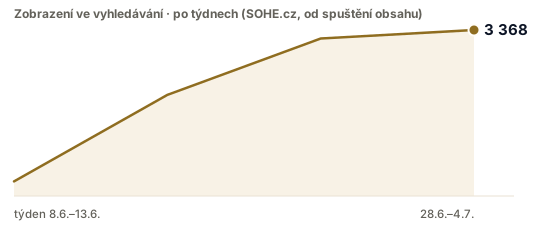
We’re building the new SOHE.cz site on exactly this principle. No generic texts about “company tradition,” but pages about electrical equipment inspections, deadlines, and legal obligations. Within 4 weeks of launching the content, it reached page 1 of Google (positions 4–7), and impressions grew roughly 8× in the first month.
5 roadblocks that stop even a good website
- No pages for specific problems: a general description of services isn’t enough. A customer searches for “electrical equipment inspection deadlines,” not “comprehensive safety services.”
- The form is hidden or complicated: when a customer has to hunt for a contact or fill in five fields, they’ll leave for a competitor where they can just tap a phone number.
- Articles don’t lead to the service: the text ends and there’s nothing underneath. No link to the order page, no phone number. The reader has nothing to do.
- No one tracks phone calls, emails, or forms: without measurement, you don’t know which article brought in the business. You’re guessing instead of knowing.
- The site doesn’t build trust: missing photos of your work, real testimonials, or the names of specific technicians. People buy from people, not from logos.
On our work samples page, you can see what that difference looks like in practice.
First, measure what you’re missing
Before you start writing new content, you need to know where your website is losing customers. The audit “Why Can’t Customers Find You?” does exactly that – it walks through your site with the eyes of a searcher and points out the specific holes.
From one such initial analysis, we discovered that a shoe repair shop’s website didn’t have a single page about a specific type of repair. Yet people were most often searching for “cost of zipper replacement on boots.” We added a page – within a month, their first lead came from Google.
At ITHOPE.cz, we see the same principle on a larger scale: year-over-year (March–May), search impressions rose by 278%. Not through ads. Through content that answers what people are actually dealing with.
First step: Pick 10 questions and answer them
- List 10 questions you hear from customers repeatedly. Ideally, phrased exactly as they say them – colloquially and specifically.
- Write an answer for each: what’s the cause, how it’s solved, a rough estimate of the cost, and what they risk by ignoring it.
- Add a clear next step: “Call us, we’ll schedule it today” – with a clickable phone number.
- Link the article to the relevant service page with an internal link.
- Measure it: set up phone call tracking and form submission tracking separately for each article.
This is the exact model we use on our own websites. On SOHE.cz, 100% of the search traffic is driven by the new expert articles. Not the homepage. Not advertising. Articles created precisely according to this methodology.